
Cursor vs Claude Code (October 2026): Which One for Your First App

Most Cursor vs Claude Code comparisons out there were written before October 2026. That month Cursor changed its plans, and for a lot of people that changes the answer. So here's the short version first, then the details.
I'm Robin. I've been coding since I was twelve, I was CTO at a couple of startups, and honestly, these days I let Claude write most of my code. I built NativeExpress, a starter for mobile apps, and I'm putting together a course for people who want to build their first app with AI. So I'm writing this for that person: you've got an app idea, you can't really code, and you want to know which of the two to pay for.
The short answer
- You want Claude to build your app: get Claude Code. It's included in Claude Pro at $20 a month. In Cursor, Claude isn't part of any plan anymore. You pay Anthropic's API price on top of your subscription.
- You want a code editor and you're fine with Cursor's own models: Cursor starts at $8 a month, with Grok and Composer.
- You can't decide: you don't have to. Claude Code runs inside Cursor's editor as an extension, so you can use Cursor as your editor and Claude Code as the agent.
Cursor vs Claude Code at a glance
| Cursor | Claude Code | |
|---|---|---|
| Made by | Anysphere, a SpaceX subsidiary since August 2026 | Anthropic |
| What it is | A code editor with an AI agent, plus a CLI and cloud agents | An AI agent: terminal, desktop app, web, and extensions for VS Code, Cursor and JetBrains |
| Cheapest plan with the agent | Free (limited), then Plus at $8 a month, Grok models only | Pro, $20 a month or $17 on annual billing |
| Claude models | From Premium ($30), billed at API list price on top | Included in every paid plan |
| Models included in the price | Cursor's Composer 2.5 and Grok 4.5 to 4.7 | Claude's models: Opus, Sonnet, Haiku |
| Usage limits | A usage pool that refreshes weekly | A five-hour window, plus weekly limits |
| Instructions file | .cursor/rules (.mdc files) or AGENTS.md | CLAUDE.md (reads AGENTS.md when there's no CLAUDE.md) |
| Skills, MCP, hooks | Yes | Yes |
Prices as of October 22, 2026, from Cursor's pricing page and Claude's pricing page.
What changed at Cursor in 2026
Two things. SpaceX bought Cursor's parent company: the deal was announced in April and closed on August 14, 2026, and Cursor now sits with SpaceX's AI team. Then in October, new customers stopped getting the old Pro plan. They now pick a plan on what Cursor calls The X Subscription: Cursor, Grok and X Premium in one bundle.
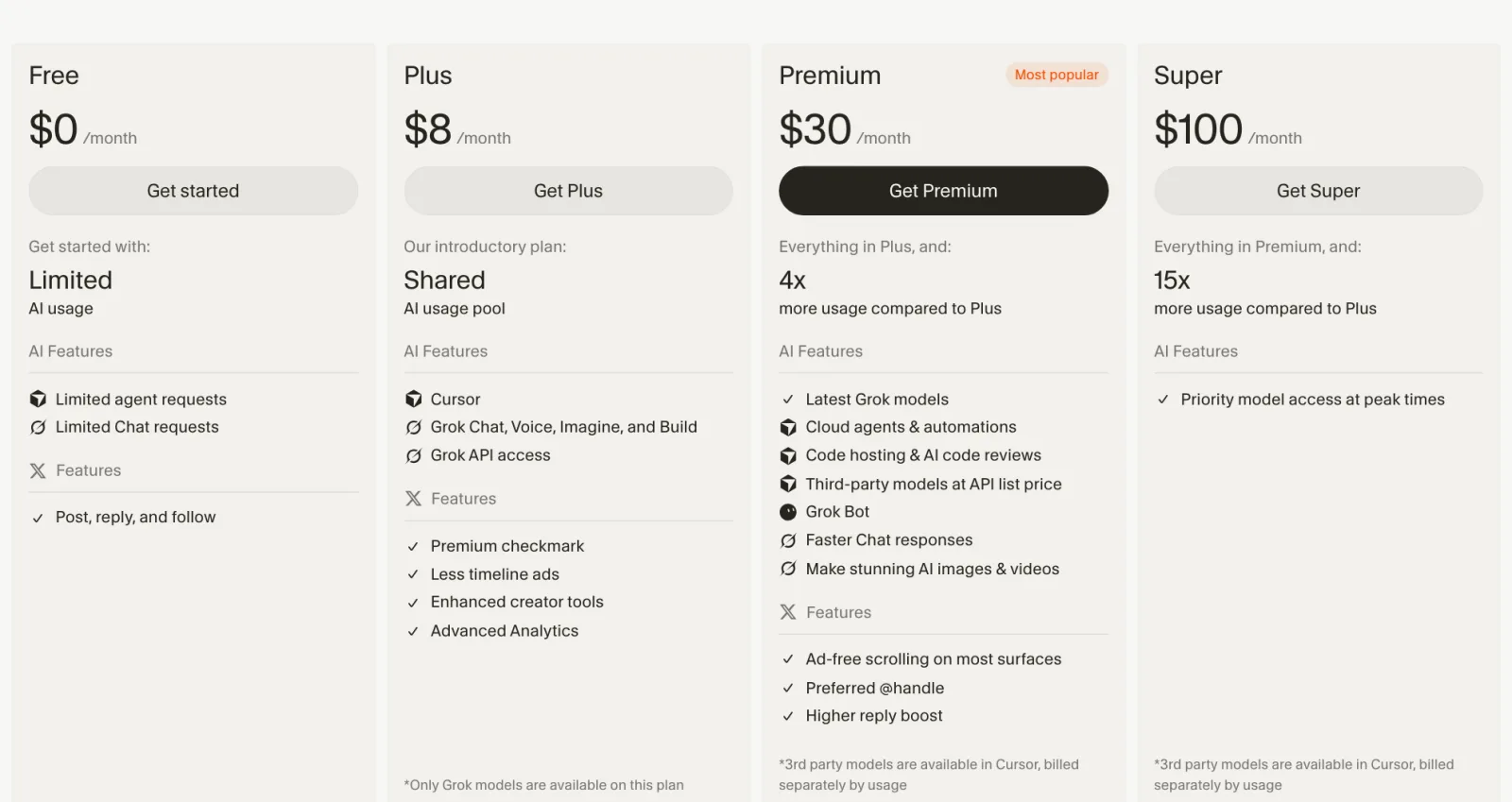
Cursor's individual plans as of October 2026. Note the small print under Premium and Super: third-party models are "billed separately by usage". Source
Here's what the plans include now:
- Free: $0, limited agent and chat requests.
- Plus: $8 a month. Cursor with Grok models only, plus the Grok apps and some X perks.
- Premium: $30 a month, 4x the usage of Plus, cloud agents, AI code reviews, and "third-party models at API list price".
- Super: $100 a month, 15x the usage of Plus.
- Ultra: $200 a month, 50x the usage of Plus.
The important sentence is on the pricing page itself: "Third Party model usage in Cursor is not included in the monthly prices shown and must be purchased separately." Third party means Claude, GPT and Gemini. Your plan's usage pool covers Cursor's own models, Grok and Composer, and it refreshes weekly.
If you already had Cursor Pro, Pro+ or Ultra before the change, Cursor says your plan "keeps working as it is" unless you change or cancel it. Switching to the new plans is permanent.
What Claude Code costs
Claude Code comes with every paid Claude plan. The free plan doesn't include it.
- Pro: $20 a month, or $17 a month billed annually.
- Max 5x: $100 a month, five times Pro's usage.
- Max 20x: $200 a month, twenty times Pro's usage (Anthropic's Max plan page).
There's no fixed message count. Limits reset on a rolling five-hour window, paid plans add weekly limits, and Claude Code shares one pool with your normal Claude chats. If you hit the limit, you can wait or keep going with usage credits at API rates.
What Claude costs inside Cursor now
This is where the math changed. If you want Claude to build your app inside Cursor, you pay the subscription and then Anthropic's API price for every token. Here are Anthropic's list prices per million tokens:
| Model | Input | Output |
|---|---|---|
| Opus 5.5 | $4 | $20 |
| Sonnet 5.5 | $2 | $10 |
An agent reads a lot. It opens your files, reads errors, and rereads everything after every change. So let's say one evening of building sends 3 million tokens to Sonnet 5.5 and gets 300,000 back. That's $6 plus $3, so $9 for the evening at list price, before any caching discount. Fifteen evenings like that in a month and you're at $135, plus your $30 Cursor plan. That's just an example. Your evenings can be cheaper or a lot more expensive.
With Claude Pro, those evenings come out of your $20 until you hit the limit. If you hit it every day, Max at $100 is the next step, and that's still one fixed price.
So it's pretty simple. If Claude is the model you want, Claude Code is the cheaper way to get it. If you're happy with Grok or Composer, Cursor's Plus and Premium are good value.
How they feel to use when you can't code
Cursor is a code editor. It's built on VS Code, so you see your files on the left, the code in the middle, and the agent in a chat on the side. When the agent changes something, you see the change highlighted and click to accept it. If you want to watch what's happening to your code, that feels good. Cursor also has a CLI and cloud agents that keep working while your laptop is closed.
Claude Code is an agent first. You tell it what you want, in the terminal or in the desktop app, and it does the work. It reads your project, runs commands, starts your app and reads the errors itself. You see what it's doing as it goes, but there's no editor around it unless you open one. You install it with one line:
curl -fsSL https://claude.ai/install.sh | bashOn Windows it's irm https://claude.ai/install.ps1 | iex in PowerShell. And if the terminal is the part that scares you, there's a desktop app that does the same thing without it.
For a mobile app, both can do the important things: start the app with npx expo start, read the errors, fix them and try again. The difference is mostly how much of the code you want to look at while it happens.
Rules: CLAUDE.md, AGENTS.md and .cursor/rules
Every agent needs a file that says how your project works: the commands, where things go, what not to touch.
- Cursor reads project rules from
.cursor/rules, and they have to be.mdcfiles. A plain.mdfile in that folder gets ignored. Cursor also readsAGENTS.mdin the project root and in subfolders. - Claude Code reads
CLAUDE.mdat the start of every session. It readsAGENTS.mdonly when there's noCLAUDE.md.
If you want both tools to follow the same rules, write an AGENTS.md and make your CLAUDE.md a one-line import of it. Then you only keep one file up to date.
Skills, MCP servers and hooks work in both: Cursor and Claude Code both read skills, both connect to MCP servers like Expo's and Supabase's, and both run hooks (Cursor's, Claude Code's).
The part neither tool fixes
This is the part these comparisons skip. The tool doesn't decide whether your app actually works.
I gave Claude an empty folder and said: build me a habit tracker, with login and a subscription. Twenty minutes later it looked done. Then I actually tried it. I could log in with any email and any password. Delete the app, and all the data's gone, because it never left the phone. And the subscribe button didn't charge anyone. It just pretended. Claude even wrote "demo mode" on the screen, in tiny letters.
Cursor wouldn't have saved me there, and neither would a better model. When you start from an empty folder, the agent has to make up everything: how login works, how payments work, where your data goes. And it makes a ton of decisions you don't notice.
Then there's Apple. My own app got rejected twice. The first time it crashed on their test iPhone, and my promo image was the same as my app icon. The second time, my paywall showed the free trial bigger than the actual price. No AI tool knows that stuff unless somebody tells it.
That's what I put into my course: the basics nobody explains, then your app on your own phone, a paywall that actually charges, and getting through Apple's review. Whichever of the two tools you pick.
Which one I'd pick for a first app
Claude Code. That's what I use for basically all my code, and with the new Cursor pricing it's also the cheaper way to get Claude. Start with Pro at $20. If you hit the limit every day, go to Max.
Pick Cursor if you want to see every file and every change in an editor, or if Grok and Composer are good enough for what you're building. And if you want both, use Cursor's free plan as your editor and run Claude Code inside it.
If you're still comparing agents, I also wrote up Codex vs Claude Code and the best vibe coding tools. And if you want the full walkthrough, here's how to build an app with Claude Code.
FAQ
Is Cursor better than Claude Code?
Neither one is better for everyone. Cursor is an editor with an agent built in and its own models, Grok and Composer. Claude Code is an agent built around Claude. If you want Claude, Claude Code is the cheaper way to get it since Cursor's October 2026 pricing change, because Cursor now bills Claude at API list price on top of your plan.
Can I use Claude in Cursor?
Yes, from the Premium plan at $30 a month. Claude isn't included in the plan's usage pool. Cursor bills it at Anthropic's API list price from prepaid credit, on top of the subscription. On Plus ($8), only Grok models are available.
Is Cursor still $20 a month?
Not for new customers. Cursor's old Pro plan was $20. Since October 2026, new customers choose between Plus ($8), Premium ($30), Super ($100) and Ultra ($200). If you already had Pro, it keeps working as it is unless you switch.
Can I use Claude Code inside Cursor?
Yes. Claude Code has an extension for VS Code, and it works in Cursor too, since Cursor is built on VS Code. You get Cursor's editor and Claude Code as the agent, on your Claude plan.
Is Claude Code free?
No. Claude Code needs a paid Claude plan: Pro, Max, Team or Enterprise, or a pay-per-token API account. The free Claude plan doesn't include it. Pro is $20 a month, or $17 a month billed annually.
Do I need to know how to code to use either one?
No, but you need the basics: what a terminal is, what GitHub is, what an API key is and where it must never go. Without those, both tools will build something that looks finished and isn't. That's exactly what the course starts with.