
Codex vs Claude Code: Pricing, Limits and Which to Pick

Codex and Claude Code are close enough in October 2026 that the subscription you already pay for is a fair tiebreaker. Both start at $20 a month, both run in a terminal, an IDE, a desktop app and the cloud, and both read skills in the same open format. On Terminal-Bench, a widely used public agent benchmark, their best runs finish one task apart. They differ in instruction files, usage limits and cloud workflow, and in the models behind them.
This comparison is for someone building an app, often a first mobile app, with one of these agents doing most of the typing. Everything below links to the page it came from, and the prices are the ones on OpenAI's and Anthropic's own pages on the day we published.
Codex vs Claude Code at a glance
| OpenAI Codex | Anthropic Claude Code | |
|---|---|---|
| Cheapest plan with the agent | Free (GPT-6 Luna in the desktop app, rolling out) | Pro, $20 a month or $17 on annual billing |
| Main paid tiers | Plus $20, Pro $100 / $200 / $500 | Pro $20, Max $100 (5x) and $200 (20x) |
| Where it runs | Desktop app, CLI, IDE extension, web, iOS, cloud tasks | Terminal, VS Code and JetBrains, desktop app, web, iOS and Android app |
| Instructions file | AGENTS.md | CLAUDE.md (reads AGENTS.md when there is no CLAUDE.md) |
| Skills folder in a repo | .agents/skills | .claude/skills |
| Models | GPT-6 Astra, GPT-6.1 Sol, GPT-6 Sol, GPT-6 Luna | Fable 5.1, Opus 5.5, Sonnet 5.5, Haiku 4.5 |
| Open source | CLI is Apache-2.0 | Not published under an open-source license |
Prices as of October 2026, from OpenAI's Codex pricing page and Claude's pricing page. The open-source row comes from OpenAI's open-source page and the license field on Anthropic's claude-code repository.
Codex pricing and Claude Code pricing in October 2026
Both companies sell the agent as part of their chat subscription, so the price you compare is the price of ChatGPT or Claude. On Claude, the agent and your chats draw from one allowance; on ChatGPT, Codex shares its usage with ChatGPT Work.
What Claude Code costs
Claude Code is included in every paid Claude plan. There is no Claude Code on the free plan.
- Pro: $20 a month, or $17 a month billed annually ($200 up front).
- Max 5x: $100 a month, five times Pro's usage per five-hour session.
- Max 20x: $200 a month, twenty times Pro's usage. The pricing page shows "From $100"; the $200 figure is on Anthropic's Max plan help page.
- Team: $25 a seat monthly or $20 annually for a standard seat, $125 or $100 for a premium seat with five times the usage.
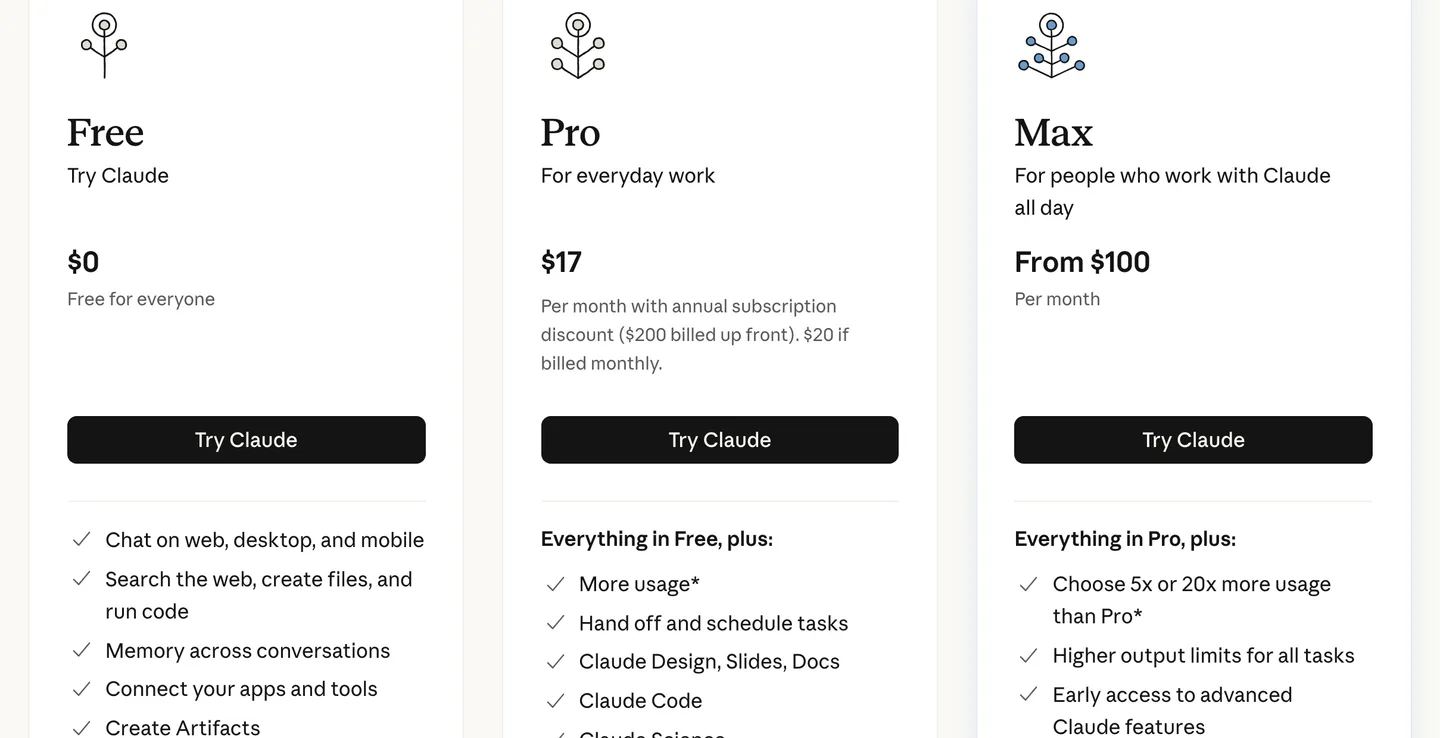
Claude's individual plans as of October 2026. Claude Code appears in the Pro list and carries into Max. Source
What Codex costs
Codex comes with ChatGPT. OpenAI's Codex pricing page lists:
- Free: $0, GPT-6 Luna in the desktop app, "subject to rollout".
- Go: $8 a month, the same Luna access.
- Plus: $20 a month. Codex on the web, CLI, IDE extension and iOS, cloud code review and Slack, GPT-6.1 Sol and GPT-6 Luna.
- Pro: $100, $200 or $500 a month. Pro plans "currently have no five-hour limit", and the $500 tier adds Astra Ultrafast.
- Business: $25 a user monthly or $20 annually, two users minimum.
- API key: pay per token at API rates. CLI, SDK and IDE only, with no cloud features.
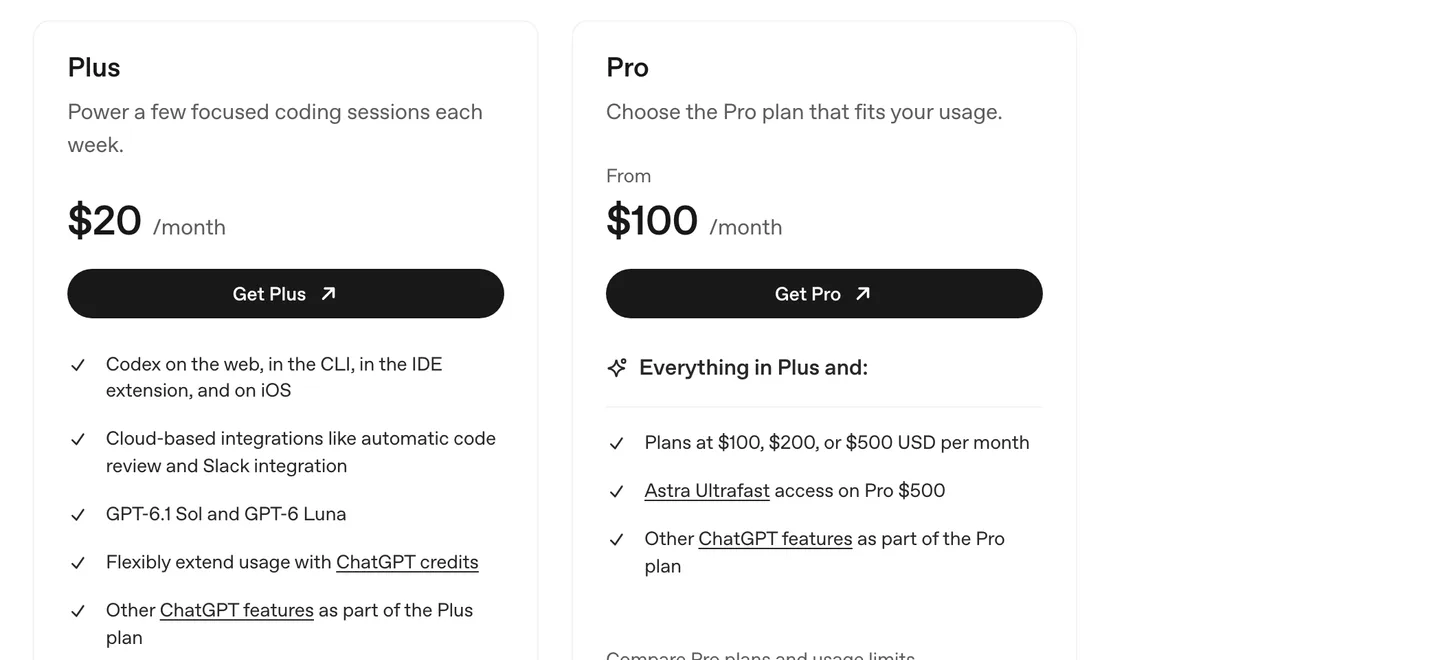
Codex Plus and Pro as of October 2026. Source
One thing to know if you search "codex pricing" and find older articles: OpenAI's model lineup has changed a lot this year. GPT-5.5 retires from Codex on all plans on October 14, 2026, and OpenAI points paying users at GPT-6 Sol as the replacement. Any guide that still quotes GPT-5 limits is out of date.
At $20, which plan gives you more?
Neither company publishes a fixed message count for its $20 plan, so nobody can tell you honestly that one gets you twice as much work as the other.
OpenAI publishes ranges. On Plus, its estimates per five-hour window are 15 to 160 local messages with GPT-6.1 Sol, 5 to 45 with GPT-6 Astra and 350 to 3,000 with GPT-6 Luna, and "weekly limits may also apply". Cloud tasks use more of the allowance than local ones.
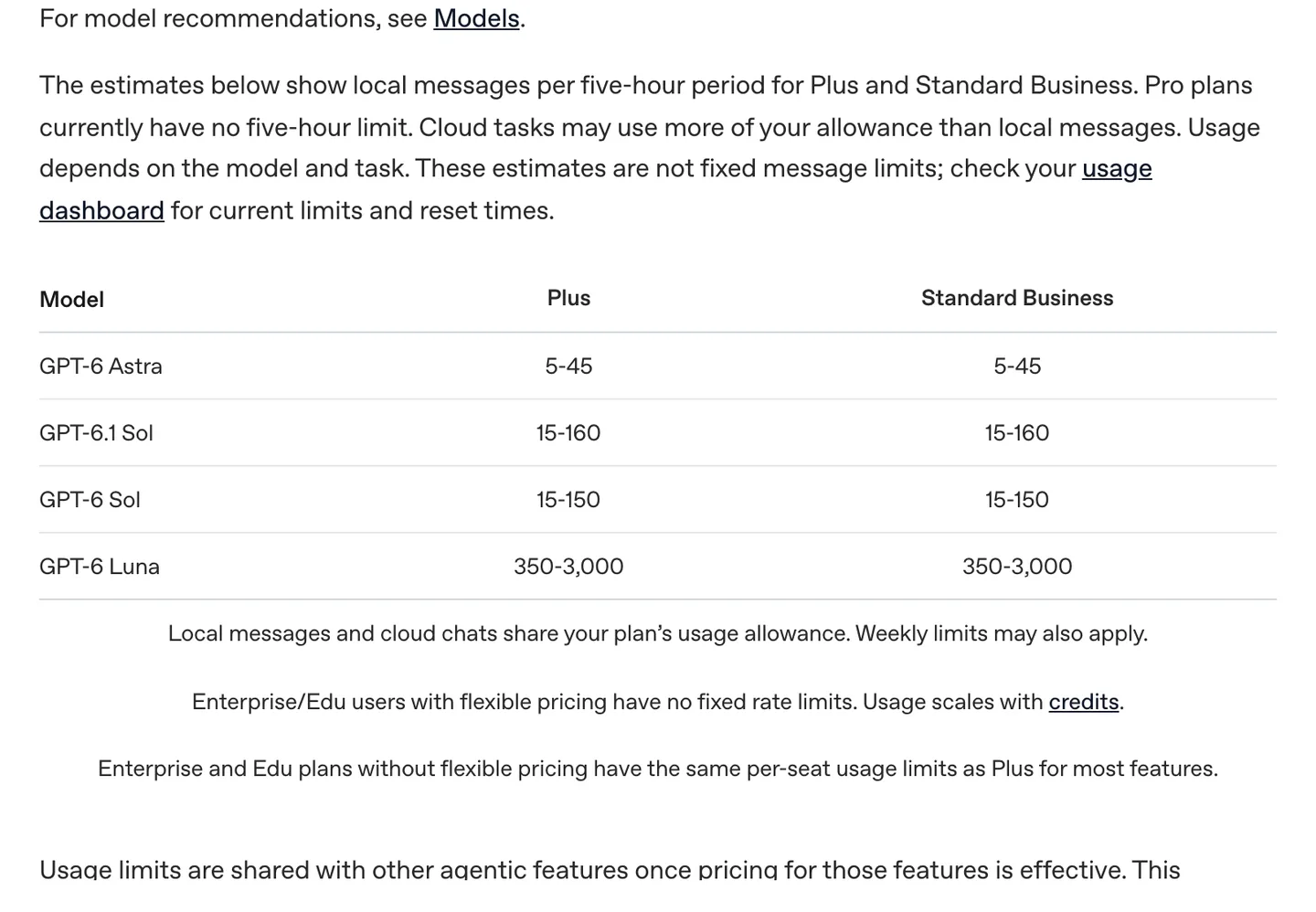
Codex's published usage estimates for Plus. The spread inside each row is the honest part: a message can be cheap or expensive depending on the task. Source
Anthropic does not publish ranges. Its pricing FAQ says every plan resets on a rolling five-hour window, paid plans add weekly limits, Claude Code and chat "draw from the same pool", and "there's no fixed message count". Pro gets at least five times the free plan's usage per session.
In practice, Codex gives you a cheap model (Luna) with a very large allowance for routine edits, which helps when you are making dozens of small UI changes. Claude Code's allowance is one pool spent by whichever Claude model you pick. Both let you keep going past the limit: Codex with ChatGPT credits or an API key, Claude with usage credits at API rates.
If you are working out a whole first-year budget, the agent is one line of several. Our cost of making an app guide adds up the store fees and services around it.
How each one runs
When both launched in 2025, Codex was best known as a cloud agent and Claude Code as a terminal tool. That split has mostly gone. Both now run in the same places, with different defaults.
Claude Code runs in the terminal, in VS Code, Cursor and JetBrains, as a desktop app, and on the web at claude.ai/code, where you can kick off long tasks on repositories you do not have locally. Web sessions are also available in the Claude app for iOS and Android. The docs describe the terminal version as "the full-featured CLI".
Codex runs in the ChatGPT desktop app, the Codex CLI, an IDE extension, and Codex Cloud, where each task gets its own workspace and "can keep working while your computer is asleep". You review the diff, ask for changes, and open a pull request from the web, desktop or mobile app.
For a mobile app, the local surfaces matter most. Your agent needs to run npx expo start, read Metro errors, run the type checker and look at what you report from the phone in your hand. Cloud tasks are good for chores that do not need the simulator, like refactoring a folder or writing tests, and both products have them.
AGENTS.md vs CLAUDE.md
Every coding agent needs a file that tells it how your project works: the commands, where code goes, what not to touch. This is where the two products look the most different, and where it matters least once you know the rules.
Codex reads AGENTS.md before doing any work. It loads a global one from ~/.codex, then walks from the repository root down to your current folder and concatenates what it finds, so a nested AGENTS.md can add rules for one part of the codebase. There is a default size cap of 32 KiB for the combined instructions, and an AGENTS.override.md for temporary changes.
Claude Code reads CLAUDE.md at the start of every session, plus notes it writes itself in what Anthropic calls auto memory. It can also read AGENTS.md, with one rule worth knowing: by default it reads AGENTS.md only when there is no CLAUDE.md in your working directory or above it.
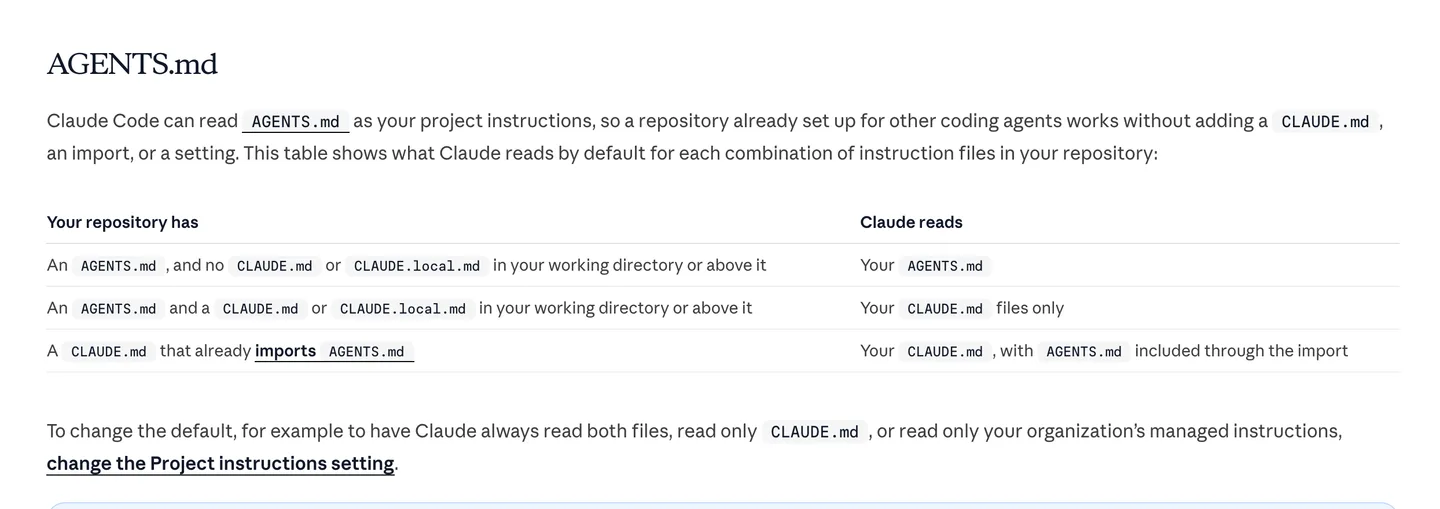
If a repository has both files, Claude Code reads only CLAUDE.md unless you import AGENTS.md or change the setting. Source
So if you want one set of instructions for both agents, write AGENTS.md and either skip CLAUDE.md or make CLAUDE.md a one-line import of AGENTS.md. Many React Native projects already start this way: create-expo-app now writes an AGENTS.md that points agents at the docs for your SDK version.
Skills, plugins and MCP
This is where the two have converged the most.
Skills
Both use the Agent Skills open standard: a folder with a SKILL.md that the agent loads when a task matches its description. Claude Code's skills live in .claude/skills/ and add extras on top of the standard, like controlling whether only you can invoke a skill. Codex's skills live in .agents/skills/ and also start with only the names and descriptions in context, loading the full file when needed.
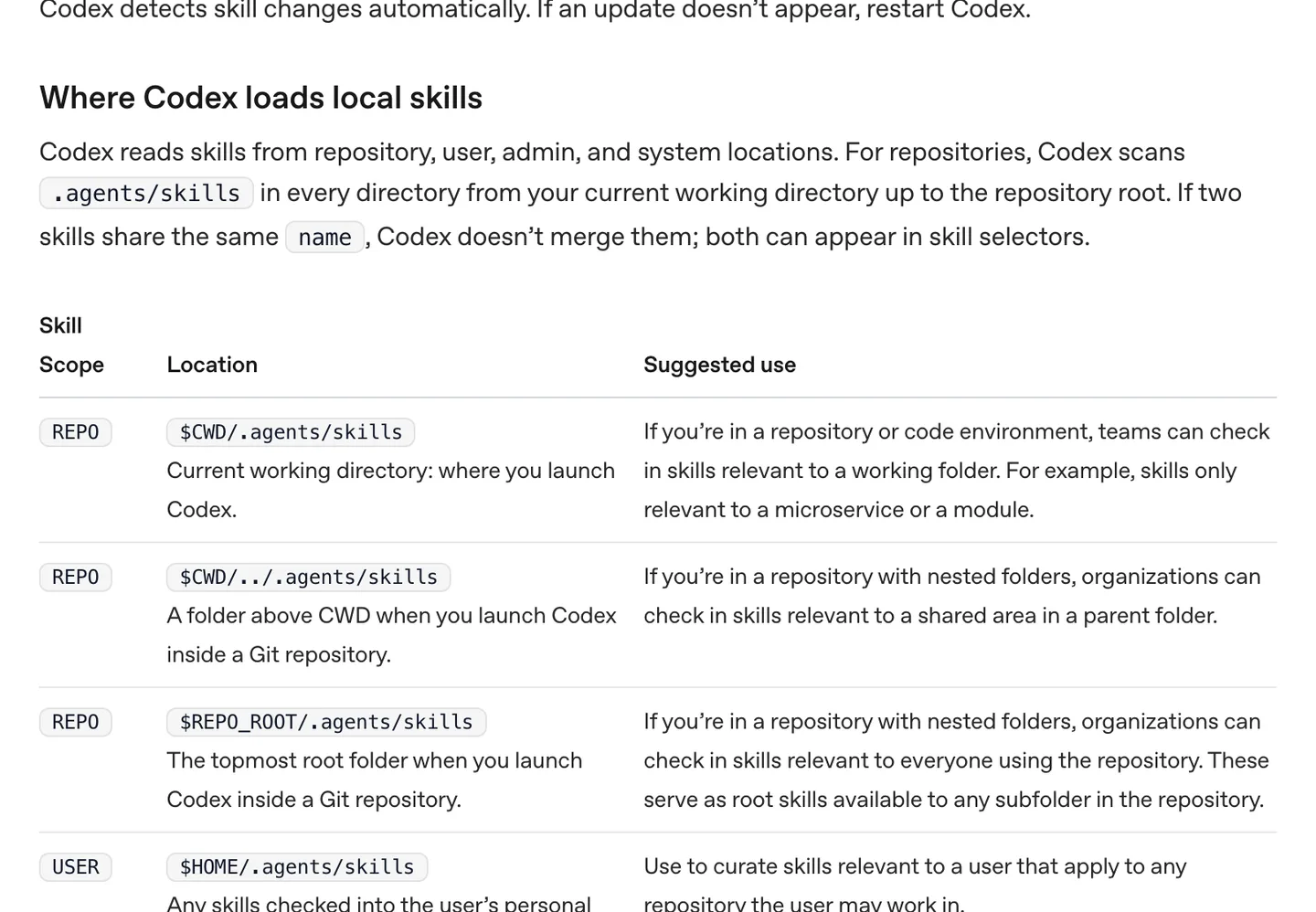
Codex looks for repository skills in .agents/skills. Claude Code looks in .claude/skills and, per its docs, reads nothing under .agents/. Source
The folder names are the practical catch. A skill written for one agent is readable by the other, but each agent only discovers skills on its own path. A project that wants to work with both has to keep a copy in each place, or symlink one to the other (Codex follows symlinked skill folders).
Plugins, MCP and hooks
Both bundle skills, MCP servers and other pieces into installable plugins. In Claude Code you run /plugin and install from a marketplace. Codex plugins come from a directory shared with ChatGPT.
Both also connect to MCP servers, local or remote. Claude Code's MCP docs and Codex's MCP docs cover the same ground: stdio servers, HTTP servers and OAuth. For app work this matters because Expo has an MCP server and agent docs and Supabase has an MCP server, and either agent can use them. Both run hooks (Codex's version) at points in the agent's loop, and both can split work across subagents.
If you want to see what a set of skills for a real React Native project looks like, our Claude Code skills for mobile apps post goes through them one by one.
Models and benchmarks
Codex's models page recommends GPT-6.1 Sol for complex coding, describing it as "near-Astra performance" at lower cost, and GPT-6 Luna for "focused, repeatable tasks". GPT-6 Astra is OpenAI's most capable model and the most expensive per message.
Claude Code's model docs map the opus alias to Opus 5.5 and sonnet to Sonnet 5.5, with Fable 5.1 as the most capable option for "tasks larger than a single sitting". Plan matters here: on Pro, Fable usage bills to usage credits, and on Max it is capped at 50% of weekly limits. Claude models have context windows of up to 1M tokens, depending on the model.
For a head-to-head number, the most useful public source is the Terminal-Bench 4.0 leaderboard, which scores agent and model pairs on real terminal tasks. As of early September 2026:
| Agent + model (max reasoning) | Tasks solved | Run cost on the leaderboard |
|---|---|---|
| Codex + GPT-6 Astra | 58.2% (192 of 330 trials) | about $3.3k |
| Claude Code + Fable 5.1 | 57.9% (191 of 330 trials) | about $6.2k |
That is one task apart, well inside the confidence interval the leaderboard draws around each score. Codex got there at roughly half the cost in that run. Opus 5.5, the model Claude Code's opus alias points to, was not on the board when we checked, and neither was GPT-6.1 Sol.
Our honest read: the published evidence does not show either one is better at coding. It does show Codex is cheaper per solved task at the top end, and that both are good enough that your instructions, your project structure and how you review the work will matter more than the logo.
Strengths and weaknesses
Where Codex is stronger
- There is a free way in. Free and Go users get GPT-6 Luna in the desktop app, so you can try Codex before you pay anything. Claude Code has no free tier.
- Clearer limits. OpenAI publishes message ranges per model, including a cheap model (Luna) with a large allowance, and Pro has no five-hour cap.
- The CLI is open source under Apache-2.0, so you can read what it does.
- Cloud tasks are built around reviewing a diff and opening a pull request, with GitHub code review and Slack on Plus.
Where Claude Code is stronger
- Its skills go further than the shared standard, with invocation control, subagent execution and dynamic context, and its hooks, plugins and memory settings are documented in detail.
- It reads both
CLAUDE.mdandAGENTS.md, so it fits into repositories set up for other agents. - Anthropic's mobile app runs Claude Code web sessions on both iOS and Android; OpenAI lists iOS for Codex.
- The Fable models are built for long, unattended sessions, and Max 20x gives heavy users room to run them.
Weaknesses to know about
- Claude Code's limits are not published as numbers, so you find the edge by hitting it.
- Codex's API-key mode drops the cloud features, so you cannot get cloud tasks on pay-as-you-go.
- OpenAI's model lineup is mid-migration (GPT-5.5 leaves Codex on October 14), so saved configs and scripts may need updating.
Using Codex or Claude Code for a mobile app
In our experience both write React Native and TypeScript well (it is the stack we recommend in our guide to making an iPhone app). What decides how a session goes is mostly what the agent finds when it opens the project.
In an empty folder the agent picks your navigation, auth, payments and folder layout from scratch, and picks them differently each time. In a project with written conventions and skills it follows the same rules every session, whichever agent you use.
A few mobile-specific things to set up whichever you choose:
- Put the commands in the instructions file: how to start Expo, run the type checker and run tests. Agents will otherwise guess.
- Add Expo's own skills or MCP server, so the agent reads docs for your SDK version instead of guessing from older ones.
- Keep App Store and Play Console sign-in, signing and review in your hands. Agents can prepare listings and builds, but the accounts are yours. Our App Store publishing guide walks through what Apple checks.
As a web developer building my first app, this boilerplate made my life so much easier.
 Andrei HudovichIndie Maker
NativeExpress ships with this already done. The repository includes skills for setup, design and conventions plus references for Uniwind and HeroUI Native, a PRODUCT.md brief the skills read, and yarn skills:doctor to report what is configured. Claude Code reads them from .claude/skills/. Five of them are mirrored in .agents/skills/, which is where Codex looks, so Codex, Cursor and Gemini CLI can use them too. The two shipping skills, store-assets and submit, are Claude Code only; the skills catalogue explains why.
Which should you pick?
You already pay for ChatGPT Plus. Start with Codex. You have it already, and the published limits make it easy to see what you are getting.
You already pay for Claude Pro. Start with Claude Code, for the same reason. If you hit limits on Opus, try Sonnet before you upgrade.
You want to try an agent without paying. Codex, through the free or Go plan, while the Luna rollout reaches you.
You are building your first app and want a lot of hand-holding. Either works. Pick the one whose skills your starter supports. If you use NativeExpress, Claude Code gets all seven skills including submission; Codex gets five.
You run long, unattended tasks. Codex Cloud is built for fire-and-forget tasks that end in a pull request. Claude Code on the web does the same, and Anthropic aims Fable at "tasks larger than a single sitting". Try both on one real task before you commit $100 or more a month.
You care most about cost per finished task. Codex, on the current Terminal-Bench numbers. Check again before you decide.
You want to use both. One for building and the other for a second opinion on a diff is a reasonable split. Write one AGENTS.md, keep skills in both .claude/skills and .agents/skills, and the project works with either.
For the wider field, see our roundups of the best vibe coding tools and the best AI app builders, and the step-by-step guide to vibe coding an app.
FAQ
Is Codex better than Claude Code?
Not by any published measure that holds up. On the Terminal-Bench 4.0 leaderboard in September 2026, Codex with GPT-6 Astra and Claude Code with Fable 5.1 were one task apart, though Codex's run cost about half as much. For most app builders the deciding factors are which subscription you already have and which instructions and skills your project ships.
Which is better, Codex Plus or Claude Pro?
Both cost $20 a month, and Claude Pro drops to $17 a month on annual billing. Codex Plus publishes message estimates and includes a cheap model (GPT-6 Luna) with a large allowance; Claude Pro gives you Claude Code with Opus and Sonnet but no published message count. OpenAI pitches Plus as enough to "power a few focused coding sessions each week", and Anthropic pitches Max, not Pro, at people who work with Claude all day, so heavy daily use means a higher tier on either side.
Is there a better coding AI than Claude?
On the current Terminal-Bench 4.0 leaderboard, OpenAI's Codex with GPT-6 Astra sits level with Claude Code and Fable 5.1, so "better" depends on the task and the cost you accept. Cursor lets you switch between models from several companies, and Google's Gemini CLI is another option. The bigger gains usually come from giving any agent clear instructions and a well-structured project.
Is Codex taking over Claude Code?
There is no data showing one replacing the other. Both products shipped new models this year, both adopted the same skills standard, and Claude Code now reads the AGENTS.md file Codex uses. They are converging more than either is pulling away.
Is Codex really good for coding?
Yes. Codex with GPT-6 Astra tops the Terminal-Bench 4.0 leaderboard as of September 2026, and OpenAI recommends GPT-6.1 Sol for most complex coding at a lower cost. As with any agent, the quality of the result depends heavily on the instructions in your AGENTS.md and on reviewing what it changes.
How much does Codex cost?
Codex is included with ChatGPT. As of October 2026, Free and Go ($8) get GPT-6 Luna in the desktop app as it rolls out, Plus is $20 a month, Pro is $100, $200 or $500 a month, and Business is $20 to $25 per user. You can also run the CLI with an API key and pay per token, without cloud features.