
Rork Review (2026): Pricing, What It Builds, and When to Use Claude Code Instead

Rork is an AI app builder for mobile apps. You describe your app in a chat, Rork builds it in the browser, and it can push it to the App Store for you. If you've got an app idea and can't code, it's one of the first tools you'll find.
I'm Robin. I've been coding since I was twelve, I was CTO at a couple of startups, and these days I let Claude write most of my code. I built NativeExpress, a starter for mobile apps, so I spend a lot of time looking at how people get from an idea to an app in the store. This review is for you if you're trying to decide between a builder like Rork and doing it yourself with an AI agent like Claude Code.
Everything about Rork below comes from Rork's pricing page and Rork's docs as of October 22, 2026.
The short version
- Rork is good for: seeing your idea on a phone fast, without installing anything. It builds native apps on its own machines, so you don't need a Mac, and it can submit to the App Store from the browser.
- What to check first: Pro is $20 a month for 100 credits. That's at most about three messages a day, and builds cost credits on top. If you need more, the next plan is $200. Your running app's AI and backend features use a separate prepaid balance. And Rork no longer builds React Native apps, so iPhone and Android are now two separate apps.
- When I'd use Claude Code instead: when you want to turn the app into a business. That means one codebase for both stores, code that's yours from the first line, and nobody's credits between you and the next change.
What Rork is
In Rork's own words, it's "a platform for building and publishing apps without writing code: native iPhone apps, native Android apps, and web apps." You describe the app, and Rork "writes the app, handles the design, runs the builds, and publishes it."
What it builds, per its technical FAQ:
- iPhone apps in SwiftUI
- Android apps in Kotlin with Compose
- web apps in React
On top of that there's a simulator, an AI App Store Reviewer that's meant to "catch App Store rejections early", a backend called Rork Cloud, and guides for adding Supabase or Firebase instead.
What Rork costs
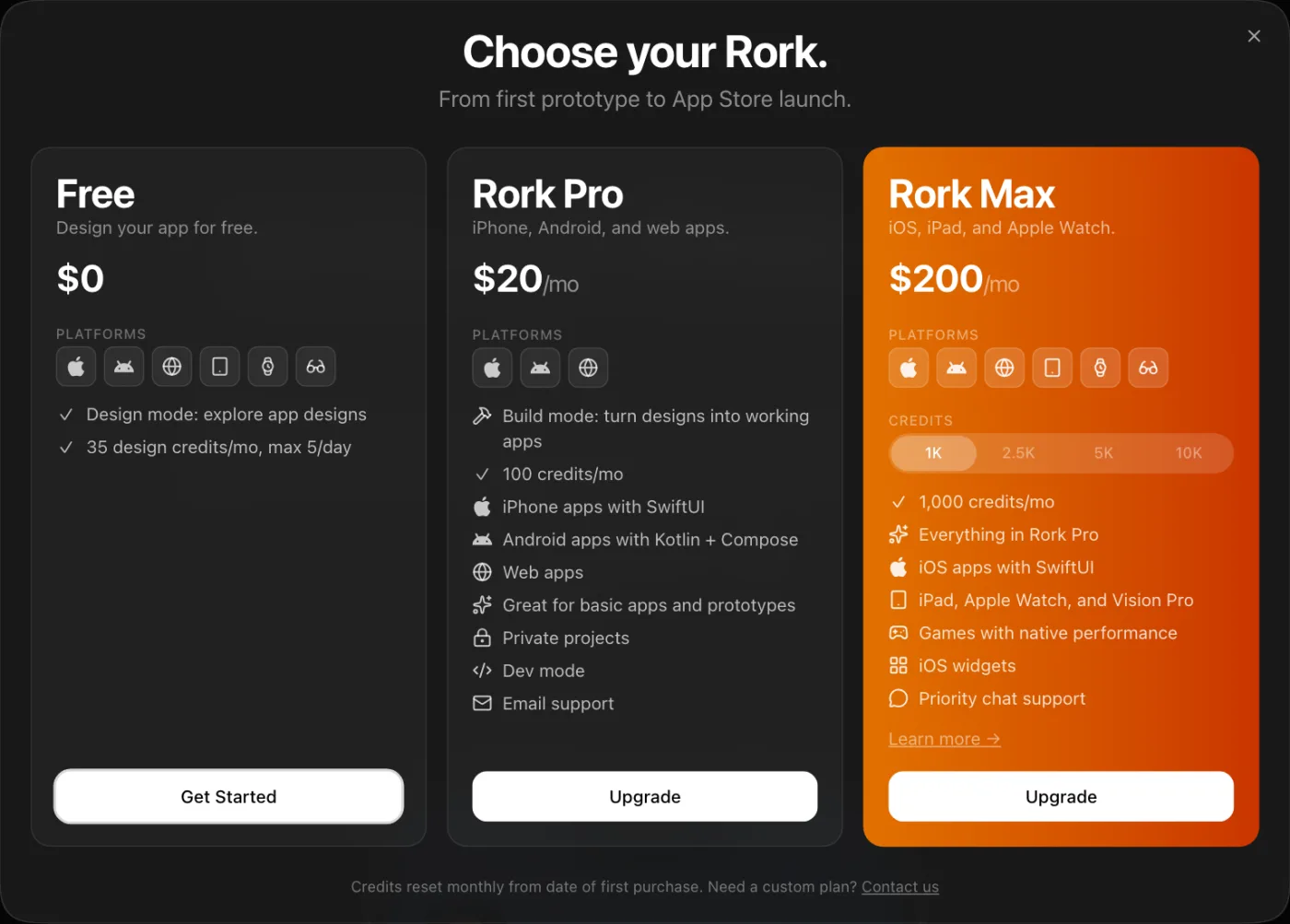
Rork's plans as of October 2026. Source
From Rork's plans page:
| Plan | Price | Credits a month | What you get |
|---|---|---|---|
| Free | $0 | 35 design credits, max 5 a day | Design mode only. You can explore designs, but you can't build a working app |
| Rork Pro | $20 a month | 100 | Build mode for iPhone, Android and web apps, private projects, Dev mode, email support |
| Rork Max | from $200 a month | 1,000 to 10,000 ($200 to $1,800) | Everything in Pro, plus iPad, Apple Watch, Vision Pro, iOS widgets and games |
Three things to know before you pay:
- Credits aren't just messages. Messages to the agent, builds, previews, generated images and audio, and publishing all spend build credits. iOS builds and cloud simulator sessions cost credits on top of the message that started them. Rork doesn't publish how many credits one message costs.
- Only Max can top up. On Pro, when your 100 credits are gone, you wait for the monthly reset or upgrade.
- Your app's AI features run on a second balance. If your app uses Rork AI Cloud for things like AI chat, images or backend functions, that's paid from prepaid cloud credits in dollars. They're separate from your plan, with top-ups from $5 to $200.
And like every route to the stores, you also pay Apple and Google: the Apple Developer Program is $99 a year, and a Google Play developer account is a one-time $25. Rork's App Store guide confirms you need your own Apple Developer account.
How far do you get with each Rork plan?
Not very far, honestly. Rork doesn't publish what one credit buys, so here's what we know.
Rork's own docs say messages, builds, previews, generated images and audio, and publishing all spend credits, and that iOS builds and cloud simulator sessions cost credits on top of the message that started them. Independent reviews put a normal message at one credit, whether you ask for a whole login screen or a blue button (Dynalord). A product designer who reviewed Rork found the biggest drain isn't the logic, it's the small UI tweaks. That's the part people underestimate. Most of building an app is small changes like "move this a bit to the left", not big features.
So, on each plan:
| Plan | Price | Credits | Per credit | What that means |
|---|---|---|---|---|
| Free | $0 | 35 a month, max 5 a day | Designs only, no working app | |
| Rork Pro | $20 a month | 100 | $0.20 | At most about 3 messages a day, fewer once builds count |
| Rork Max | $200 a month | 1,000 | $0.20 | About 33 a day |
| Rork Max | $500 a month | 2,500 | $0.20 | |
| Rork Max | $900 a month | 5,000 | $0.18 | |
| Rork Max | $1,800 a month | 10,000 | $0.18 |
How many messages does an app take? Dynalord estimates 30 to 50 messages for a simple app with 5 to 8 screens, 100 to 200 for a moderate app with iteration, and 300 to 500 or more for a complex one. That's an estimate, and it doesn't count builds. But even then, a normal app with a few rounds of changes is one to two months of Pro, and you're waiting for the reset in between.
And here's the catch: Pro can't top up. Only Max plans can buy more credits. So if your 100 credits are gone on day ten, you either wait until next month or jump from $20 to $200. There's nothing in between.
And that's on top of what you already pay
If you already pay for ChatGPT or Claude, Rork is a second subscription on top. Then your app's AI features run on Rork's prepaid cloud credits, and Apple wants $99 a year.
Compare that with Claude Code. It's included in the Claude Pro plan for $20 a month, the same plan you'd use to chat with Claude. There are no credits per message. You build until you hit the five-hour limit, and then it resets. If you hit it every day, Max is $100. So for the price of Rork Pro alone, you can have the agent that builds your app and the chat you were paying for anyway.
To me, that makes Rork expensive for anything past a first prototype. Building your app really means hundreds of small changes.
The big change: Rork dropped Expo
If you read an older Rork review, it probably says Rork builds React Native apps with Expo. That's no longer true. Rork's docs say: "You can no longer create Expo (React Native) projects in Rork." New projects are Swift, Kotlin or web. Old Expo projects keep working, but Rork recommends rebuilding them natively.
Their reason is quality: their own benchmarks found the agent builds better Swift apps. That's fair, and native SwiftUI apps feel great on an iPhone.
But here's what it means for you. With React Native and Expo, one codebase runs on iPhone and Android. With Rork now, an iPhone app and an Android app are separate native apps, even if they live in one project. So if you want to be in both stores, you have two apps to build, fix and keep in sync. You pay for that in credits.
What Rork does well
- No setup. Everything runs in the browser. You don't install anything or open a terminal.
- No Mac needed for iOS. Rork "builds the app on its own machines, so you do not need Xcode, a Mac, or any other build account".
- Publishing from the browser. You start the submission in Rork and finish the listing in App Store Connect.
- Native apps. SwiftUI on iPhone and Kotlin on Android, with widgets and Live Activities on iOS.
- You can leave. On a paid plan, "Paid users own all generated code." You export through a two-way GitHub sync, so you can also edit locally and bring changes back.
Where it gets harder
Honestly, the same place it gets hard with every AI tool. I once gave Claude an empty folder and said: build me a habit tracker, with login and a subscription. Twenty minutes later it looked done. Then I tried it. I could log in with any email and any password. Delete the app, and all the data was gone. And the subscribe button didn't charge anyone. It just pretended.
A builder hides a lot of that from you, which is great until something doesn't work and you can't see why. Rork's own FAQ says the browser preview can differ from the real app: "not all native features are available in the browser". So test on your phone before you trust anything.
Apple is the other one. My own app got rejected twice. The first time it crashed on their test iPhone, and my promo image was the same as my app icon. The second time, my paywall showed the free trial bigger than the actual price. Rork's App Store Reviewer is a good idea for exactly this. But whatever tool you use, you're the one who has to understand why Apple said no.
Rork vs Claude Code
| Rork Pro | Claude Code | |
|---|---|---|
| Price | $20 a month for 100 credits | Included in Claude Pro, $20 a month (source) |
| How it's limited | Credits per month. Builds and simulator sessions cost extra credits | A five-hour usage window plus weekly limits |
| What it builds | Separate SwiftUI and Kotlin apps, or a React web app | Whatever you choose, for example one React Native app for both stores |
| Where your code lives | In Rork. Exported to GitHub on paid plans | In a folder on your computer from the first line |
| Backend | Rork Cloud, or Supabase or Firebase | Whatever you choose, for example Supabase |
| Do you need a Mac for iOS? | No | No, if you build in the cloud with EAS Build |
| Setup | None, it's all in the browser | You install it and learn a few basics first |
The last row is the honest trade-off. Rork asks you to learn nothing up front. Claude Code asks you to learn what a terminal, GitHub and an API key are. Once you know those, you're not stuck inside anyone's credits or anyone's platform.
Which one I'd pick
If you want to see your idea on a phone this weekend and you don't care about the code yet, Rork is a good way to test it. Start on Free to explore designs, and pay for one month of Pro when you want something that works.
If you want the app to become a real business, with real users and a paywall that charges, I'd build it with Claude Code. Start from something that already works: login, payments, a backend and the App Store setup. That way the AI only builds the part that's actually your app. That's how I build mine, and it's what my course teaches from zero.
For more options, see Lovable alternatives, the best AI app builders, and Cursor vs Claude Code.
FAQ
Is Rork free?
Partly. The free plan gives you design mode with 35 design credits a month, up to 5 a day, so you can explore what your app could look like. Building a working app needs Rork Pro at $20 a month for 100 credits, or Rork Max from $200 a month.
Does Rork use React Native?
Not for new projects. Rork stopped creating Expo (React Native) projects. New apps are native: SwiftUI for iPhone, Kotlin with Compose for Android, and React for web apps. Existing Expo projects in Rork keep working.
Can you export your code from Rork?
Yes, on a paid plan. Rork says paid users own all generated code, and you export it through a two-way GitHub sync.
Do I need a Mac to publish an iPhone app with Rork?
No. Rork builds the app on its own machines and starts the App Store submission from the browser. You still need your own Apple Developer account, which costs $99 a year.
What is a good Rork alternative?
It depends on what you're missing. Another browser builder like Lovable or Bolt keeps you in the browser, but they're mostly built for web apps. If you want to own the code from the start and ship one app to both stores, a coding agent like Claude Code or Cursor with a React Native and Expo project is the usual next step.
Is Rork worth it?
For testing an idea quickly without code, yes. For building a real app, it gets expensive. Pro's 100 credits are about three messages a day before builds, Pro can't top up, and the next plan is $200 a month. Check that, and whether you want to maintain separate iPhone and Android apps, before you build a business on it.
How many credits does a Rork message cost?
Rork doesn't publish it. Independent reviews put a normal message at one credit. Rork's own docs say iOS builds and cloud simulator sessions cost credits on top of the message that started them, so a message that triggers a build costs more.
What happens when you run out of Rork credits?
On Rork Pro, you wait for your monthly reset or upgrade to Rork Max, which starts at $200 a month. Only Max plans can top up credits as you go. Credits reset on the monthly anniversary of your first purchase.