
Lovable Alternatives in 2026: 7 Options Compared Fairly

The best Lovable alternative depends on why you are leaving. For another chat-based web builder, try Bolt, Base44 or v0. For a builder that also makes mobile apps, Replit, Rork or Vibecode. For full control, run Claude Code or Cursor on a codebase you own. If Lovable already does what you need, stay.
Lovable is one of the quickest ways to turn an idea into a web app, and most alternatives cost about the same. Switching makes sense when you hit a specific wall: unpredictable credits, the need for a phone app, or wanting the code on your own terms.
We checked every price on the tools' own pricing pages. All prices are as of October 2026 and they change often, so check the linked page before you pay.
Why people look for Lovable alternatives
Three reasons come up again and again, and each one points to a different alternative.
Credits are hard to predict
Lovable charges in credits, and in Build mode the cost of a message depends on the work it does. Its plans and credits page gives examples: "Make the button gray" costs 0.50 credits, "Add authentication" 1.20, a landing page with images 2.00. It also says those numbers are illustrative and real costs vary with your project.
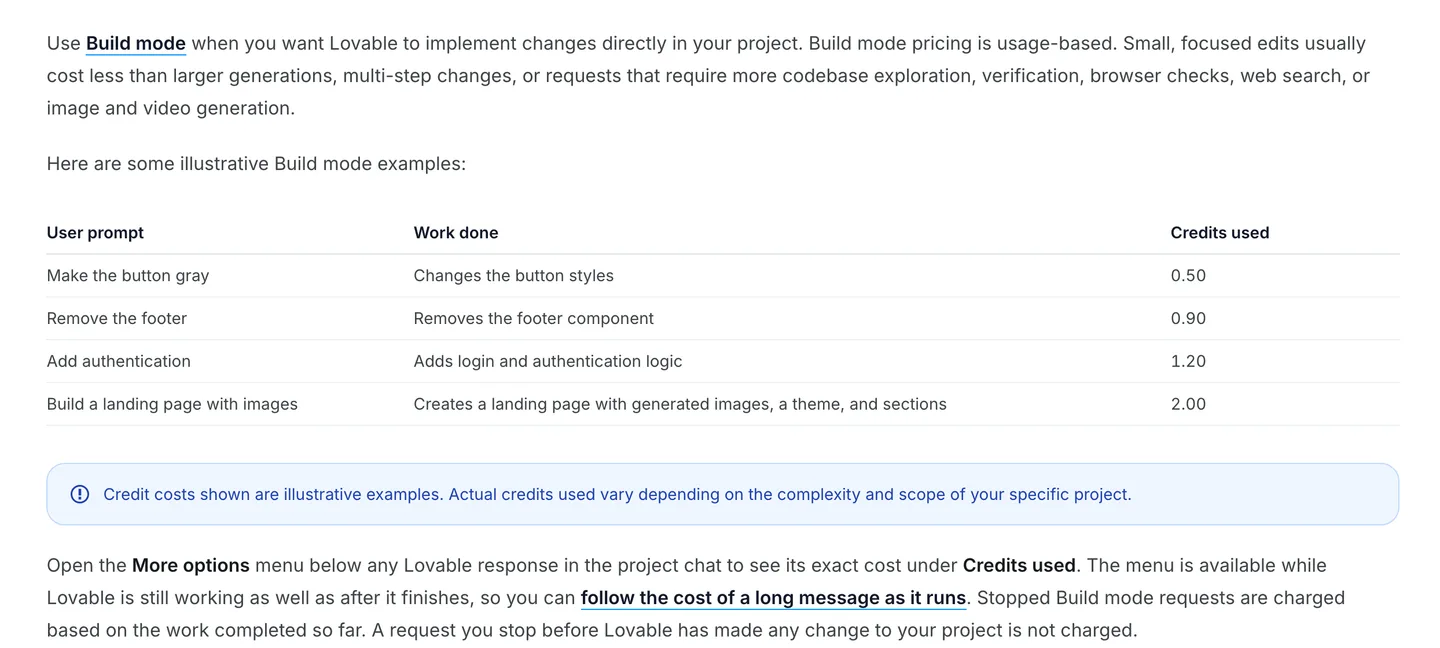
Lovable's own examples of what a Build mode message costs. Real costs vary by project. Source
On Pro at $25 a month for 100 credits, that is plenty for a weekend project. It gets tight when you are fixing bugs every day, because every fix is a message and an agent sometimes needs three tries. Hosting is metered too: Lovable Cloud usage is billed by the resources your app uses, with 20 Cloud credits a month included before it draws on your main balance.
To be fair to Lovable, this model is no worse than its competitors'. Bolt bills tokens, Replit bills by effort, v0 bills dollars of usage. Lovable is upfront about it: you can see what each message cost in the chat, unused Pro credits roll over for a month, and you can buy top-ups. If credits are your only complaint, a different credit system may not fix it. Owning the code and paying a flat subscription for a coding agent might.
You want a mobile app
Lovable builds web apps. Its FAQ says it does not generate React Native projects, and the suggested routes to the App Store are a PWA or a Capacitor wrapper set up outside Lovable. We covered this in detail in can Lovable make mobile apps, including how to keep your Lovable backend and rebuild the screens natively, so we won't repeat it here. If a store listing is the reason you are reading this, skip ahead to Replit, Rork and Vibecode, and to the section on owning the code.
You want more control over the code
Lovable says you own your code, and paid plans can download the whole project as a zip or keep it in sync with GitHub. Two limits show up once you go further. When you connect GitHub, Lovable creates a new repository from the project; you "cannot connect an existing repository or start a project from one". And you don't pick the framework: new projects use TanStack Start on a Postgres backend through Lovable Cloud or Supabase.
That stops being fine when you want to start from code you already have or work in your own editor every day.
What Lovable does well
Before the list: Lovable is very good at getting a full web app (sign-in, database, storage, payments) live on a URL quickly, and its backend is a sensible choice. Lovable Cloud is built on Supabase's open-source foundation, so the data model you design there is not a dead end. People run real businesses on it. If your product lives in a browser and the bill is fine, you don't need an alternative.
The best Lovable alternatives in 2026
Here is the short version, then a section on each.
| Tool | What it builds | Cheapest paid plan | Code you can take | Mobile app route |
|---|---|---|---|---|
| Lovable | Web apps (TanStack Start) | $25/mo, 100 credits | Zip download, GitHub sync | PWA or wrapper outside Lovable |
| Bolt | Web apps, Expo for mobile | $25/mo, 10M tokens | Download | Expo project you build and submit |
| Base44 | Web apps on Base44's backend | $20/mo, 100 message credits | Zip and GitHub from Builder ($50/mo) | Web view wrapper, Builder plan |
| Replit | Web and mobile apps | $20/mo, $20 of usage | Full workspace | Expo, App Store via Launch |
| v0 | Next.js web apps | From $30/user/mo | GitHub sync | None |
| Rork | Native iOS and Android | $20/mo, 100 credits | GitHub sync on paid plans | Built in for iOS |
| Vibecode | React Native and Expo | $20/mo, $20 of usage | Download, SSH from Cursor | App Store submission included |
| Claude Code or Cursor | Whatever your repo is | $20/mo | It is your repository | Whatever you build |
Monthly prices as of October 2026. Most tools are cheaper billed yearly.
Bolt
Bolt is the closest like-for-like swap. You describe the app in chat, it writes the code in a browser workspace, and Pro is $25 a month starting at 10M tokens, with unused tokens rolling over to the next month. The difference that matters for some people: when you ask Bolt for a mobile app, it creates an Expo project, so you get React Native code instead of a website.
The catch is the last mile. Bolt's guide has you download the project and run the build and submission yourself. Our mobile app builders roundup shows those steps.
Pick Bolt if you like how Lovable works and want the option of an Expo app later.
Base44
Base44 is the one most often compared with Lovable, and it gets its own section below. In short: it is aimed at people who don't want to think about code at all, with the database, sign-in and integrations handled by Base44's own backend.
Replit
Replit is a full development environment with an AI agent on top. That makes it more flexible than Lovable and a little less hand-holding. It is also the only general builder here that builds mobile apps with Expo and walks you through App Store submission from inside the editor. Head-to-head below.
v0
v0 is Vercel's builder. It works with Next.js, Tailwind and shadcn/ui, deploys to Vercel and syncs with GitHub. Plus starts at $30 per user a month with $30 of included usage, plus $2 of free daily credits when you log in. The free plan is capped at 7 messages a day.
If you are a developer or plan to become one, v0's output is close to what a professional Next.js team writes, which makes it easy to keep working on outside v0. It does not build mobile apps.
Pick v0 if you want a web app on the most common React stack and plan to host it on Vercel.
Rork and Vibecode, if you want a phone app
If the real reason you are leaving Lovable is that you want something in the App Store, use a builder made for mobile.
Rork Pro is $20 a month for 100 credits and, according to its pricing page, builds iPhone apps in SwiftUI and Android apps in Kotlin with Compose. Rork Max, from $200 a month, adds iPad, Apple Watch and Vision Pro.
Vibecode builds React Native and Expo apps. Plus is $20 a month for $20 of AI usage, billed at cost, and credits roll over while your plan is active. Every paid plan includes App Store submission, source download and an SSH connection from Cursor.
Both get a first version onto your phone fast, and both are still credit-based, so the cost question comes with you.
Claude Code or Cursor on your own codebase
The last option is to stop renting a builder. You keep a real project on your computer, and a coding agent like Claude Code (included in Claude Pro at $20 a month) or Cursor ($20 a month for the individual plan) writes most of the code.
You get any framework, any library, any native module, and your own GitHub repository from the first commit. You pay a subscription for the agent instead of credits per change. The price is more setup on day one, and no hosted preview that just appears in a browser tab. See the Lovable vs Claude Code section below for when that trade is worth it. New to this? Start with what is vibe coding.
Base44 vs Lovable
Which is better, Base44 or Lovable? They overlap a lot. Both turn a chat into a working web app with sign-in and a database. The differences are in who they are built for and what you can take with you.
Pricing. Base44 charges per message, not per amount of work. Its plans run from Free (25 message credits a month) to Starter at $20 a month for 100 message credits, Builder at $50 for 250 and Pro at $100 for 500, about 20% less on yearly billing. Integration credits, used when your app calls things like AI or email, are counted separately. Lovable's Pro is $25 for 100 credits, but a credit there can buy more or less than one message depending on the request.
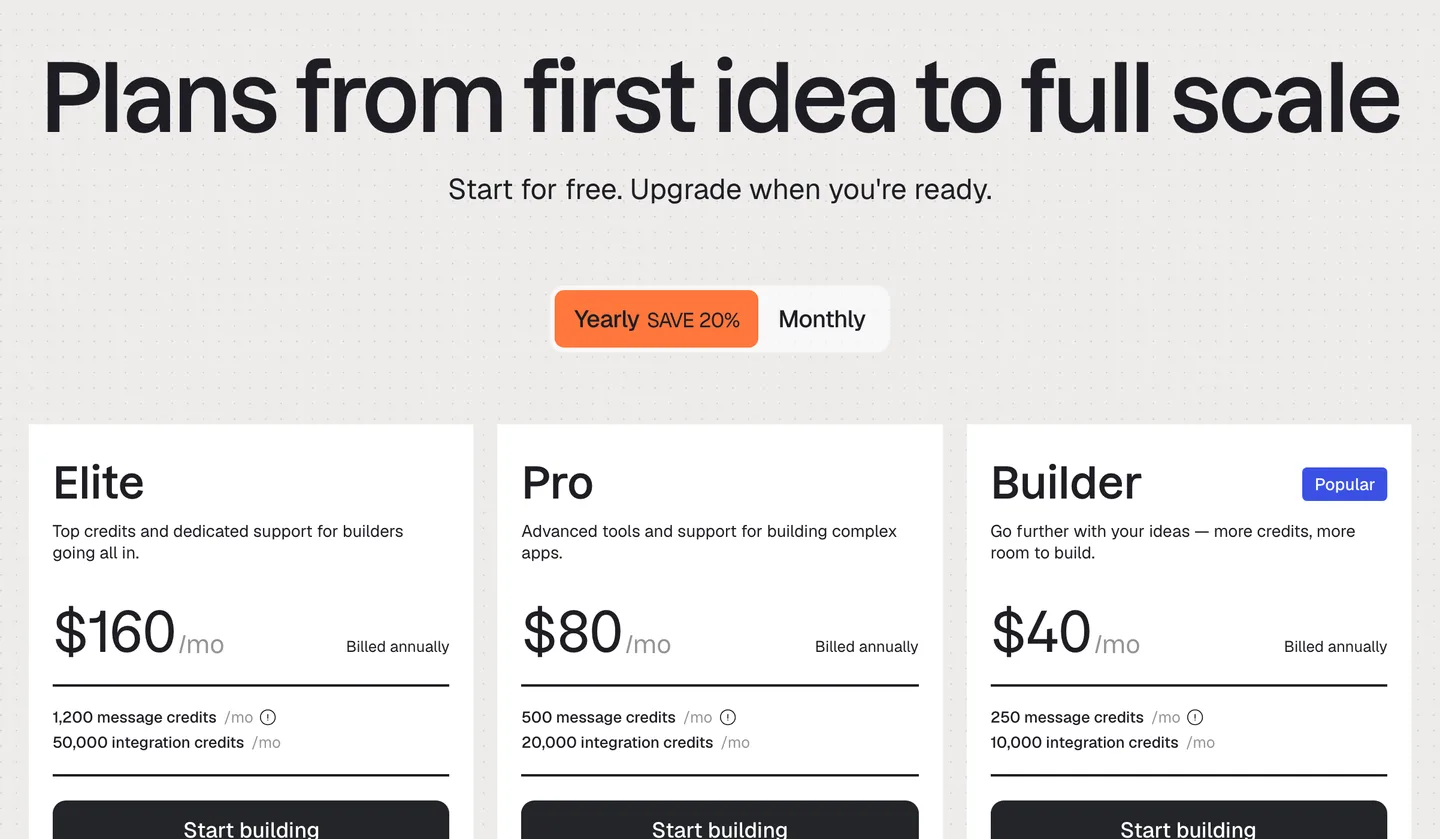
Base44's plans on yearly billing, as of October 2026. Monthly billing is $50 for Builder and $100 for Pro. Source
Backend and portability. This is the real difference. Base44 runs your data, sign-in and functions on its own managed backend. You can export the code as a zip or to GitHub from the Builder plan, but its developer docs say that in local development your frontend still "connects to the hosted Base44 backend for data and functions". Lovable's backend is Supabase underneath, either Lovable Cloud or your own Supabase project, which is an open-source stack you can export and move. If you think you might leave one day, Lovable is the easier one to leave.
Mobile. Base44 can package your app for the stores from the Builder plan up. Its docs are clear about what that is: "a lightweight native wrapper around your web app" that runs it in a web view. You submit it yourself. Lovable has no packaging step at all, so Base44 is ahead here, but a wrapper still has to pass Apple's minimum functionality rule.
Verdict. Base44 for a non-technical founder who wants an internal tool or simple app live with the least thinking, and who is happy to stay on Base44. Lovable if you care about the code and the backend being portable, or you might hand it to a developer later.
Replit vs Lovable
Replit and Lovable both have an AI agent that builds the app for you, but they come from opposite directions. Lovable started as an app builder for non-developers and added code editing. Replit started as an online coding environment for developers and added an agent.
Pricing. Replit Core is $20 a month ($18 billed yearly) and includes $20 toward the strongest models, plus a Free Mode allowance for everyday Agent work. Paid Agent work uses effort-based pricing: a simple change is usually under $0.25, a larger task costs more, and Replit asks before a paid action starts. Pro is $100 a month for teams.
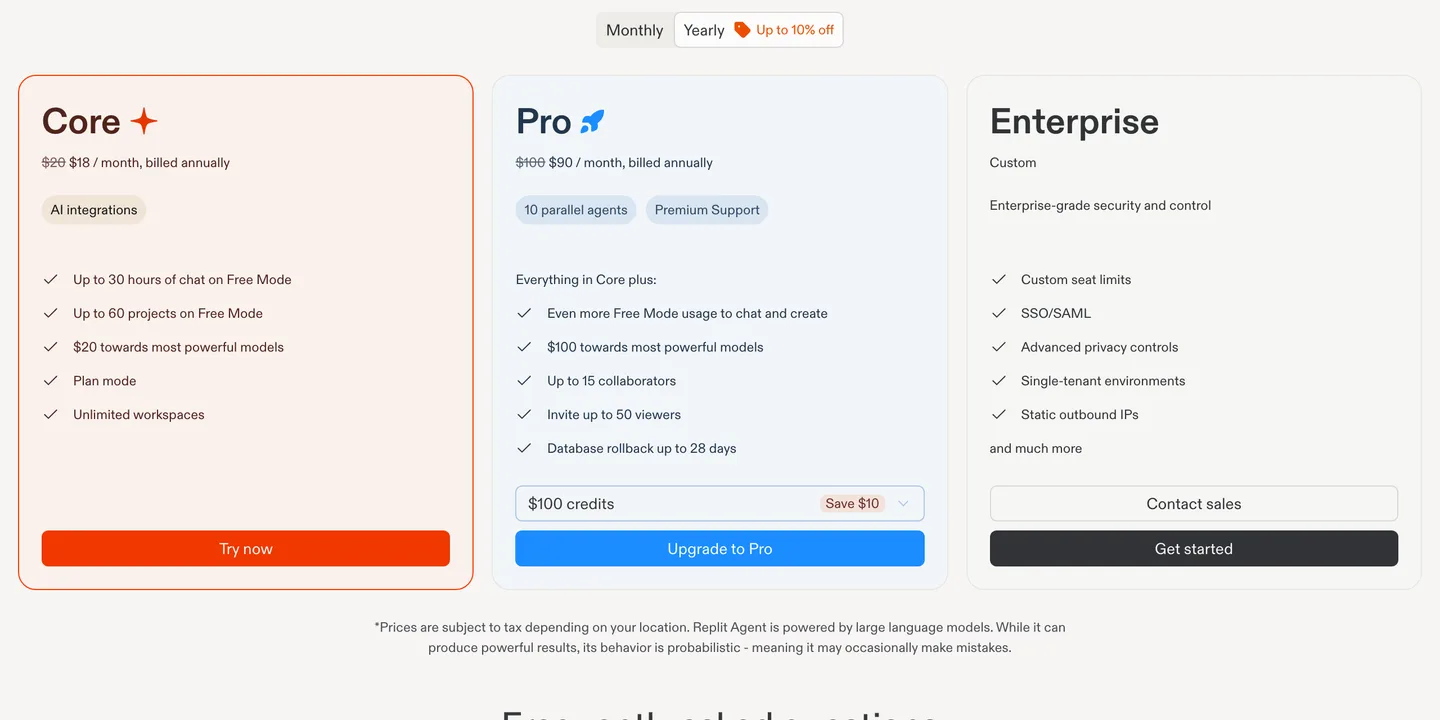
Replit's plans on yearly billing, as of October 2026. Core is $20 billed monthly. Source
What you can build. Lovable is web only. Replit builds web apps and, since its mobile launch, native apps with Expo and React Native. You preview on your phone in Expo Go, and Replit has a publishing flow that configures your Apple certificates and sends builds to App Store Connect. You still need your own Apple Developer account.
How it feels. Lovable gives you a cleaner, more guided experience, and its designs tend to look finished sooner. Replit shows you more: files, a shell, logs, a database. That is more to learn, and more room to fix things yourself when the agent gets stuck.
Verdict. Lovable for a polished web app with the least friction. Replit if you want one tool for web and mobile, or you expect to outgrow the guided experience.
Lovable vs Claude Code
This comparison gets searched a lot, and the two are less alike than it looks. Lovable is a hosted product: an editor, an agent, a backend and hosting in one tab. Claude Code is an agent that works in a folder on your computer. It reads your files, runs commands and edits code, and everything else (framework, database, hosting) is your choice.
When Lovable wins. You want a live preview a minute after your first prompt, you don't want to install anything, and the app is a web app. For a first prototype, Lovable is faster.
When Claude Code wins. You want to start from an existing codebase, use a framework Lovable doesn't offer, build a native app, or stop paying per change. Claude Pro is $20 a month with Claude Code included, and you are not charged by the edit. The cost is setup: you install Node, open a terminal, and make decisions Lovable used to make for you.
You can use both. Lovable's Git sync means a project can live in GitHub, so plenty of people prototype in Lovable and then open the same repository in Claude Code or Cursor for the harder parts. It is also how most Lovable apps end up on phones: the Supabase backend stays, and a coding agent writes native screens against it. If you are weighing coding agents against each other, see Codex vs Claude Code.
If what you want is a native app you own
Many people searching for Lovable alternatives want one thing: their app in the App Store, with code they control.
NativeExpress is our React Native and Expo starter for exactly this. You buy it once and get the full source in a private GitHub repository. It uses Supabase for auth (Google, Apple and email), Postgres with row-level security, edge functions and storage. That is the same backend family as Lovable Cloud, so if your Lovable app runs on Supabase, pointing NativeExpress at your project is configuration, not a migration. The Lovable mobile article walks through the steps.
On top of that it ships RevenueCat subscriptions with entitlements checked on the server, three AI features, push notifications, and skills that tell Claude Code, Cursor or Codex where code goes before they write any. You still do real work: the agent writes most of the code, and you make decisions, sign in to services and test on your phone. No mobile experience needed. Store accounts and App Review stay yours.
Sign-in with Google, Apple and email
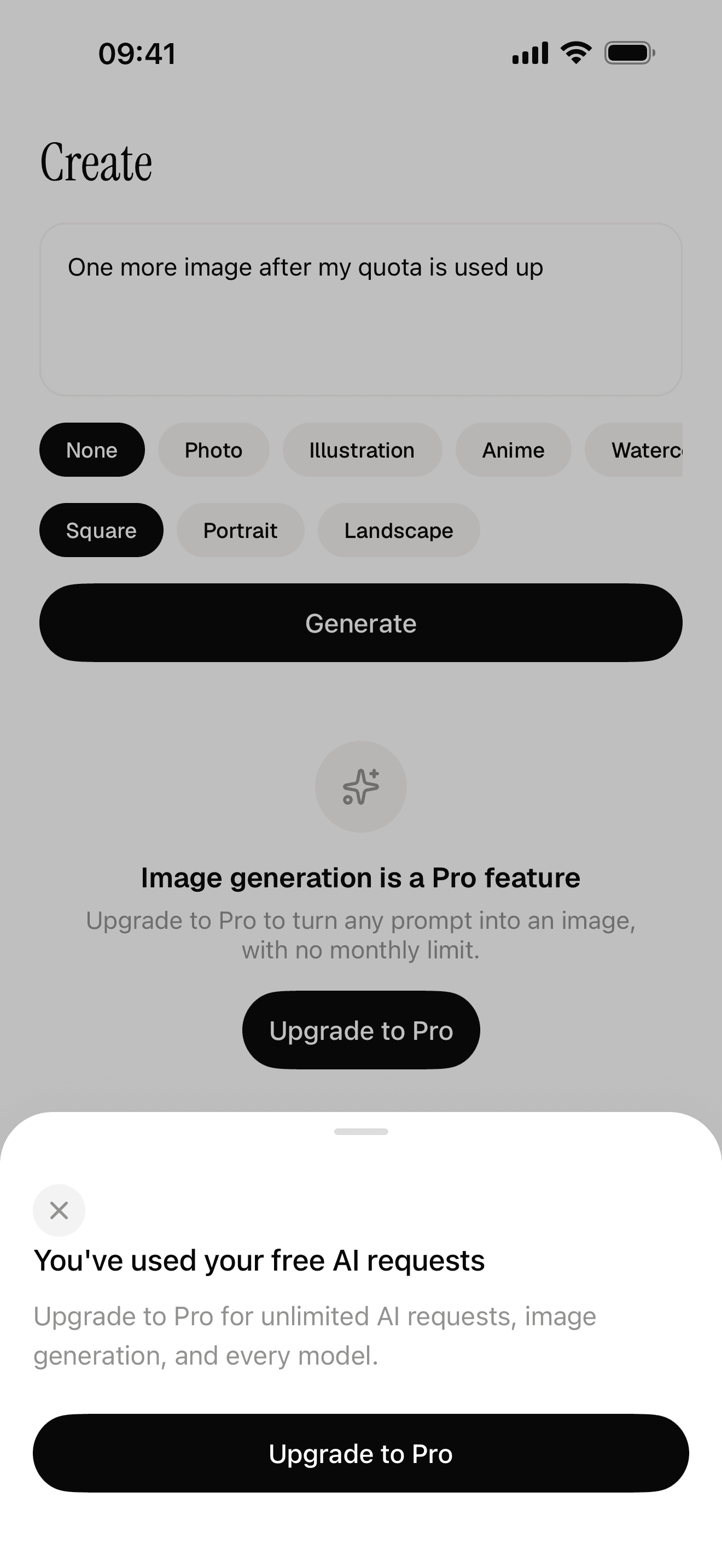
Free quota and a paywall the server decides

Streaming AI chat
Coming from React, the transition to React Native was super smooth thanks to Native Express.
 MiguelIndie Maker
Which Lovable alternative should you pick?
Find the row that describes you.
| If you want... | Pick |
|---|---|
| The same experience with a different billing model | Bolt (tokens that roll over) or Base44 (per message) |
| The least technical path to a simple web app | Base44 or Lovable |
| A web app on Next.js, hosted on Vercel | v0 |
| Web and mobile from one tool | Replit |
| A phone app prototype this weekend | Rork or Vibecode |
| A backend you can take with you | Lovable (Supabase) or your own code |
| No per-change credits, full control | Claude Code or Cursor on your own repo |
| A native app you own, ready to charge for | Claude Code or Cursor on NativeExpress |
| A web app, and Lovable is working | Stay on Lovable |
If you are still deciding what kind of tool you need at all, the best AI app builders covers the whole field, and how much it costs to make an app puts numbers on each route.
FAQ
Is there a chat-based AI builder that can replace Lovable?
Yes. Bolt, Base44, v0 and Replit all build apps from a chat, with a live preview, much like Lovable. Bolt is the closest in feel, Base44 is the least technical, v0 produces Next.js apps for Vercel, and Replit also builds mobile apps with Expo. For phone apps specifically, Rork and Vibecode are chat-based builders made for mobile.
Is Lovable worth it?
For web apps, usually yes. Pro at $25 a month gets you a working app with sign-in, a database and hosting faster than almost anything else, and the Supabase backend underneath means you are not trapped. It is less worth it if you need a native mobile app, which it does not build, or if you are iterating heavily every day and the credits run out, in which case a coding agent on your own code is often cheaper.
Which is better, Base44 or Lovable?
Base44 is better if you want the simplest path, per-message pricing and a store wrapper built in, and you are happy to keep your app on Base44's backend. Lovable is better if you want a portable Supabase backend, a cleaner handoff to a developer and code you can run elsewhere. Their entry prices are close: $20 a month for Base44 Starter, $25 for Lovable Pro.
What are the best Base44 alternatives?
Lovable is the closest alternative, with a Supabase backend you can export. Replit suits people who want web and mobile in one tool, and Bolt is a good fit if you want token pricing and an Expo option. If you want to stop depending on any builder's backend, use Claude Code or Cursor on your own codebase.